
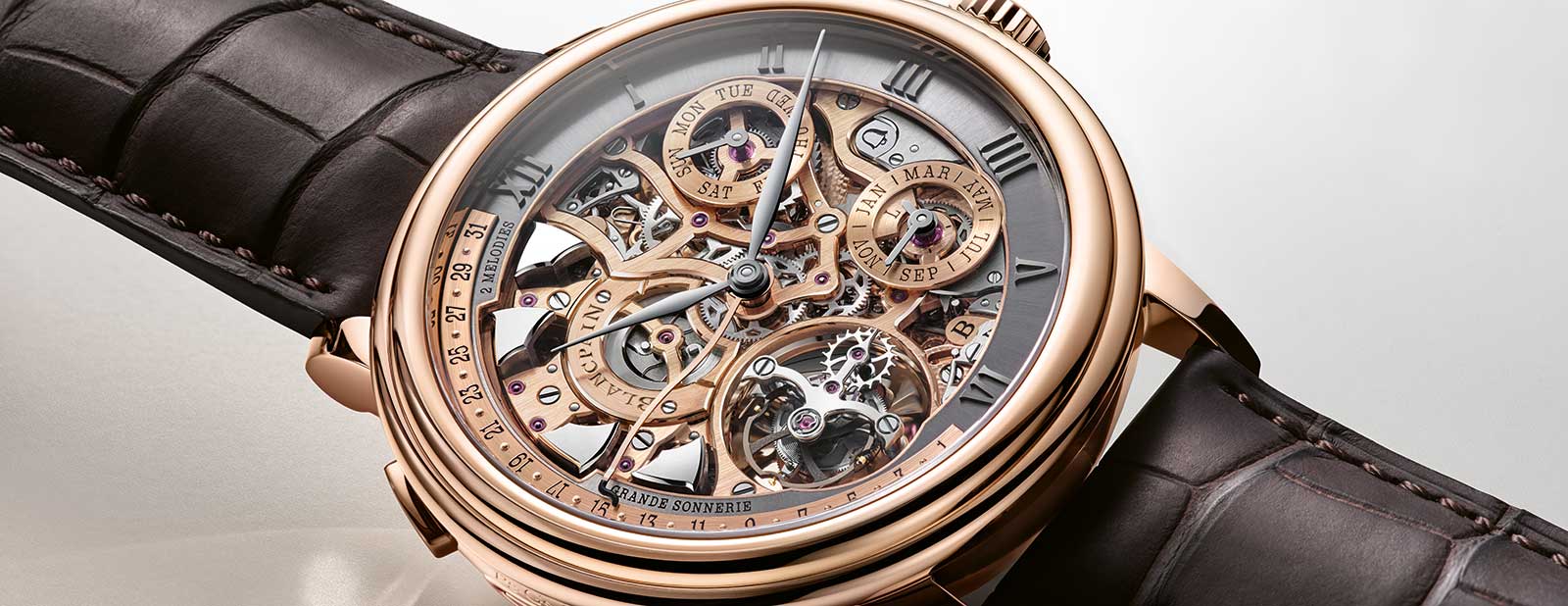
Grand Ambition: Inside Blancpain’s Grande Double Sonnerie
Editorial
Grand Ambition: Inside Blancpain’s Grande Double Sonnerie

Marc A. Hayek — grandson of Nicolas G. Hayek Sr., the irrepressible visionary credited with rescuing the Swiss watch industry from collapse and forging the Swatch Group into a global powerhouse, and nephew of Nick Hayek Jr., its current CEO — has always been something of an enigma to me.
The Hayek name is steeped in charisma; Nicolas Sr. filled rooms with his presence. Marc, by contrast, has always preferred watchmaking itself to life in the spotlight. I first met him properly during my original stint at Revolution in 2013, when Wei Koh invited me to join his Baselworld Blancpain appointment. As brand CEO, he was shy, humble and palpably self-effacing, with a charming reluctance to be the center of attention. Even then it was clear: Marc Hayek would always speak through watches rather than words.

Marc A. Hayek, President & CEO of Blancpain
So when I arrived in Le Brassus in early November and was greeted not by a gatekeeper or a handler but by a beaming Marc Hayek himself, I knew instantly that what lay ahead was different. He doesn’t beam without reason. What we were about to see mattered. And as it turned out, the watch waiting behind the next door, the Grande Double Sonnerie that was eight years in development and decades in the dreaming, was the defining technical creation of his tenure so far at Blancpain. If the Hayek family history has always been written in bold strokes, this was Marc’s chapter: quieter, more introspective, yet no less monumental.

Blancpain Grande Double Sonnerie in white gold
Blancpain had done something unprecedented for this unveiling: it had uprooted part of its secret laboratory in Le Sentier (the one even marketing isn’t permitted to enter) and rebuilt it temporarily on-site at HQ so that invited journalists could see precisely how the Grande Double Sonnerie came into being. Banks of specialized instruments, acoustic rigs, laser-vibration analyzers and movement prototypes stood ready. “This piece,” someone said quietly, “represents every craft Blancpain has ever mastered.”

The secret laboratory in Le Sentier
A Unique Dual-Melody System
The story began a decade ago, when Marc Hayek set an audacious brief. He didn’t simply want Blancpain to create a grande sonnerie, no matter how rare and exalted the complication is. Instead, he wanted to redefine what a wrist-worn chiming watch could be. The watch would need to play two distinct melodies instead of one; it would have to play the full Westminster sequence on the hour; it had to run with four hammers and four gongs, tuned not for simple tones but for actual musical notes; and above all, it must be wearable and robust, not a safe-bound showpiece. “He wanted something different, something unique,” one of the senior engineers told me. “Not just a grande sonnerie. That would be too easy.”

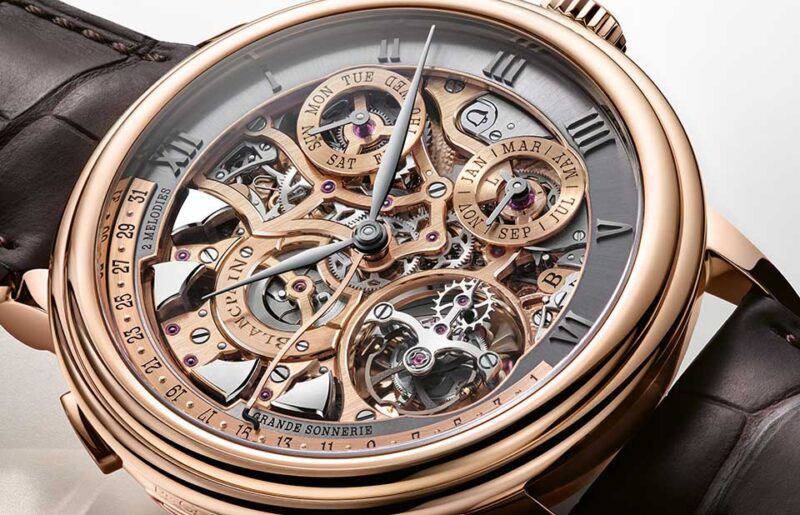
Details of the dial, the four hammers can be found between the 9 to 12 o’clock positions

Assembling the gongs
Hayek himself echoed this sentiment with characteristic clarity. “This project took eight years from concept to completion,” he said. “But we didn’t have to rethink the approach, because the brief remained unchanged from the very beginning: to create a grande sonnerie that would open an entirely new category of timepieces — one capable of playing two distinct melodies and chiming the four quarters on the full hour, with wearable dimensions.”
It is worth spelling out what this means in practice. In grande sonnerie mode, the watch strikes the hour count, then plays the appropriate portion of the selected four-note melody as each quarter passes, and at the top of the hour it follows the hour strike with the full four-bar melody. In petite sonnerie mode, the hour count is struck only on the hours, followed by the full four-bar melody, while the quarters are struck at each quarter, marked solely by their respective melodies without repeating the hour. The minute repeater functions on demand, sounding the hours, then the relevant quarter melody and finally the minutes whenever the wearer chooses to activate it. The owner may choose between the Westminster tune or Blancpain’s original composition at any time, switching instantly with a pusher on the caseband.
Behind this, a selector linked to the case controls a cam that defines the three positions: grande sonnerie, petite sonnerie and silent. A four-tooth star mounted on the cannon pinion releases the mechanism at each quarter, lifting the main lever that drives the racks. In grande sonnerie, the cam allows the hour rack to read the hour snail whenever the star triggers a release, so the hours are always repeated before the quarter melody. In petite sonnerie, a dedicated lever blocks the hour rack at the quarters but leaves it free on the full hour; an hour cam on the same star raises this lever at the top of the hour, allowing the hour rack to fall and strike the hour once before the melody. In silent mode, a silencing lever lifts the main click away from the ratchet mechanism, the heart of the sonnerie drive, so all passing strike is disabled, while a separate path keeps the minute repeater available as long as there is sufficient energy in the strike barrel. But ultimately, the main event is the ability to switch between two different melodies.
From the outset, the team knew this would not be a modular watch. The movement would have to be fully integrated with the sonnerie, the perpetual calendar and the flying tourbillon all sharing a single mainplate. This was not just philosophical purity; it was practical necessity. A stacked construction would have made the watch unwearably thick.

Close-up of the 4Hz flying tourbillon
“Blancpain’s philosophy has always been to avoid shortcuts,” Hayek explained. “The ambition was never to take the easiest road, but the most demanding one, the road that allows the beauty of mechanics to fully express itself. Integrating the sonnerie, the perpetual calendar and the flying tourbillon into a single mainplate was a natural extension of that mindset. And it was the only way to achieve the remarkably compact and wearable profile of 47mm diameter and 14.5mm thickness, dimensions that would have been impossible with stacked modules.”

Assembling the flying tourbillon into a single mainplate with the perpetual calendar

The compact perpetual calendar mechanism with a retrograde date
The scale of the challenge required total internal control. “For the Grande Double Sonnerie, Mr. Hayek’s intention was very clear: the entire project had to be carried out 100 percent in-house,” Christian Lattmann, Vice President, Head of Product Development at Blancpain told me. “This ensured complete mastery of every component from the movement and acoustic system to the tuning, calendar and gongs.” Keeping development internal also secured the 13 patents ultimately integrated into the piece. “Very important also,” he added, “all the know-how and patents stay at Blancpain and will offer us a lot of new possibilities of innovation.”
A Special Collaboration with Eric Singer
Before the final movement ever touched a polishing tool, Blancpain built three generations of prototypes. These were deliberately undecorated, bare-metal constructions created for one purpose only: to test, stress and validate the mechanical logic of the watch. The first prototype contained the entire gear train up to the tourbillon and the winding system.
The second added the sonnerie timing mechanism and endured five years’ worth of simulated shock and fatigue testing; hammers, levers and racks were pushed through hundreds of thousands of strikes. The third introduced the perpetual calendar, allowing the team to shock-test the integrated movement to 1,300g and cycle it through extreme aging simulations. “We tested it as we test everything,” Hayek said. “Because a Blancpain grande sonnerie can’t be fragile, it must be wearable.”

Blancpain Grande Double Sonnerie
The dual-melody system is at the heart of the watch’s identity. Interestingly, it was not a late-stage idea or a change of direction. “Including not just one, but two selectable melodies did not reshape the architecture midway,” Hayek emphasized. “It was part of the vision from the outset. The movement was conceived from day one to accommodate this dual-melody capability, and the entire construction was designed around that ambition.”
To achieve this, the engineers developed a vertical stack of two quarter racks, each cut with its own pattern of teeth. One governs the full Westminster sequence; the other carries the Blancpain melody composed in collaboration with a close friend of the brand, Eric Singer.

A closer look at the unusual strike works that consist of two quarter racks, each with a different tooth pattern: one for the Westminster sequence and the other for Blancpain’s original composition
Singer’s contribution deserves more space than the usual footnote of “musician collaboration.” He is not simply the drummer of KISS; he is one of the most technically respected rock drummers of the past four decades. With a career spanning more than 75 albums, he has played with giants like Black Sabbath, Alice Cooper, Gary Moore, Brian May and more. Offstage, he is a deeply knowledgeable watch collector and this combination of musical precision and horological curiosity made him the natural choice to compose the second melody.

Marc A. Hayek and Eric Singer
The constraints were formidable: the melody could use only four notes (Mi, Sol, Fa, Si), it had to follow the exact tempo of Westminster, and it could not repeat a note within a phrase. As Singer joked, “When the Blancpain team showed me the technical specs, I didn’t understand a single word — except the part that said: only four notes.” Yet he embraced the challenge. Working with his longtime collaborator Derek Sherinian, he composed 10 variations before Blancpain selected the final melody, one that is distinctly more lyrical, warmer, more intimate than Westminster, yet perfectly aligned with the movement’s mechanical boundaries. It gives the Grande Double Sonnerie a second voice, and with it, a second personality.
Technical Insights into the New Movement
“The movement uses two superimposed quarter racks, each with its own tooth pattern,” Lattmann explained. “The tolerances are almost immeasurably fine. The mounting holes of the racks are hand fitted by the watchmaker to achieve the smallest possible play, on the order of a micron. The melody selector is governed solely by the column wheel.” The complexity is staggering, but the result feels effortless. A flick of the selector button, and the personality of the watch changes entirely.
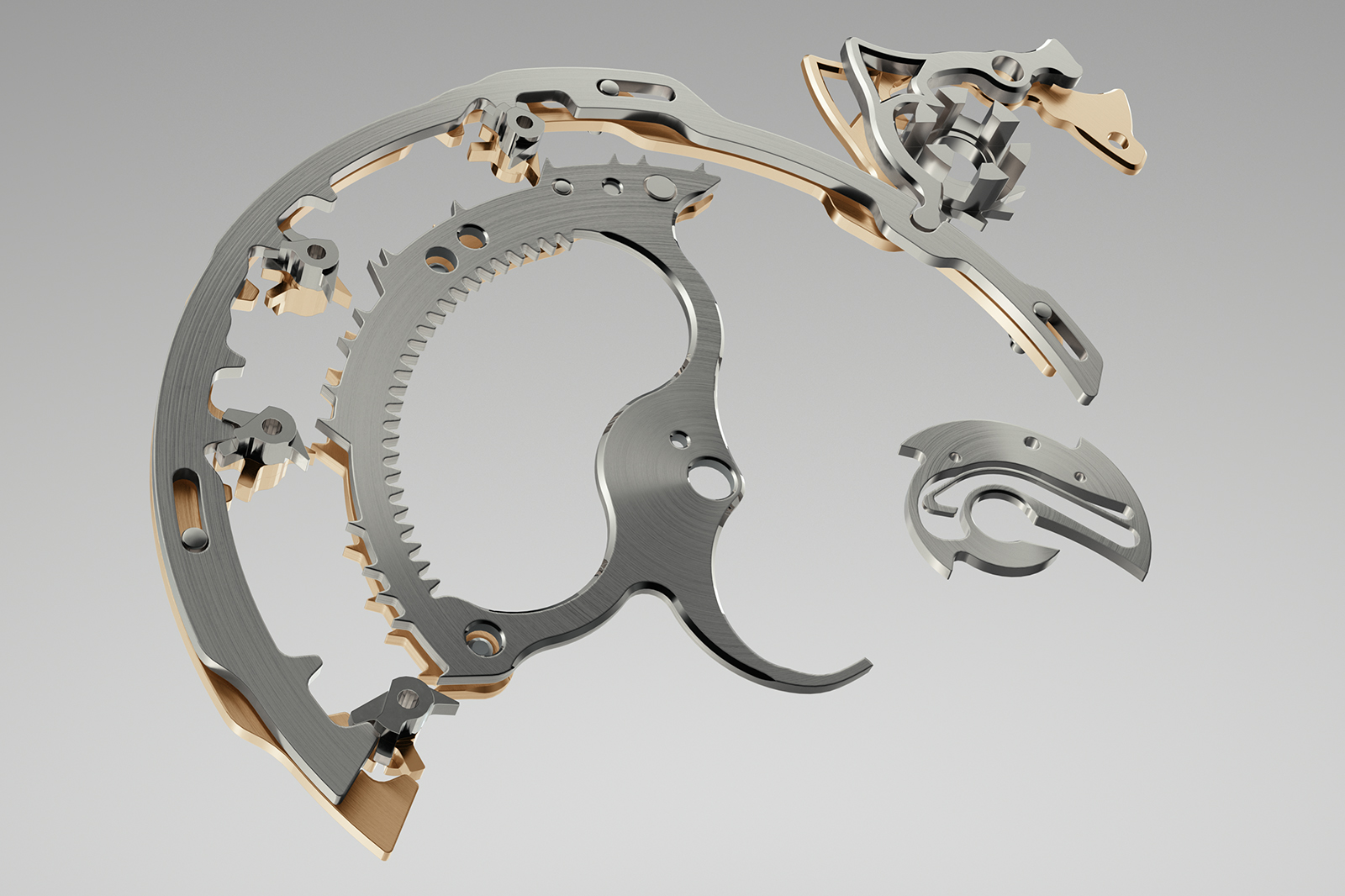
The tune selector is controlled by a column wheel

The selector button
If the architecture is the skeleton, the acoustics are the soul. “The greatest challenge was not volume, it was musicality,” Hayek told me. “There is a world of difference between a minute repeater that simply alternates two tones, and a grande sonnerie capable of playing music with four hammers and two full melodies composed of four verses of four notes each.”
The team had to master not just pitch, but tempo; not just notes, but partial frequencies, the harmonic overtones that give each note its color. According to Hayek, the aim was never brute loudness. It was to create a “round, warm, generous tone and a sound that makes you smile.” The patented acoustic membrane beneath the bezel became essential to this, acting simultaneously as amplifier and filter, enhancing richness while softening harshness.
Achieving the four perfect notes required an extensive materials study. Eleven metals were tested before the team settled on red gold for its warmth and ability to transmit harmonics with minimal distortion. Even then, the solution was not merely to shape the gongs but to sculpt their internal geometry. Variable cross-sections created complex vibrational patterns; lasers measured frequency spectra; watchmakers filed tips by microns. “If you go too far,” one said, “the whole gong is lost. You’ll have to start again.”
The hammers were designed to be as heavy as possible within the available space. “Each hammer includes adjustable stops that let us set the exact distance between hammer and gong, preventing buzzing and ensuring stable pitch for both melodies,” said Lattmann. “The order of the notes and their tempo are controlled entirely by the teeth of the quarter rack and the way those teeth actuate the hammer-triggering levers. The lifts must be hand adjusted by the watchmaker,” he continued, “retouching their length by microns to reach timing accuracy on the order of a hundredth of a second.”
And then there were the people. As Hayek said proudly, “This is not a one-man show. It is a team that has delivered this project over many years.” Only two watchmakers — Romain and Yoann — are able to assemble the Grande Double Sonnerie. Their apprenticeship for this watch involved months of collaborative work with engineers and acousticians, learning not just mechanics but elements of music theory.

Yoann and Romain
Meanwhile, in the decoration atelier, the demands of the project reshaped traditional practice. “Élisabeth, who has worked here for 15 years, spent six months training under Marie-Laure, our Meilleur Ouvrier de France engraver,” Hayek told me. “She had to master the specialised gestures of hand-engraving to execute over 135 interior angles to the highest standard. Karine, who has also worked at Blancpain for 15 years, adorns the main plate with over 3,400 circular graining patterns [perlage] in three different sizes, the smallest measuring just 0.7mm.” The finishing department created no fewer than 271 new tools expressly for this watch, a testament to the fact that innovation was required at every stage, even for decoration.
Assembly takes nearly a year. The movement is built once for testing, then entirely disassembled, cleaned and assembled again. At the end of this process, a small gold plaque is screwed onto the movement: on one side, the Blancpain signature, on the other (visible only to a future watchmaker), the engraved name of the person who built it.

Assembling the plaque
The result is astonishingly wearable. As Hayek has insisted from the outset, “I wanted a grande sonnerie that could be worn. A watch must live on the wrist, not in a safe.” Despite 1,053 components for the movement (out of a total of 1,156 including habillage) and unprecedented acoustic architecture, the watch sits at 47mm by 14.5mm, which is bold but not unwieldy, grounding its complexity in everyday possibility. It can be personalized, even at the level of melody, provided the mechanical constraints are respected.
Despite the fact that only two watches can be made per year, there is no elitism here in allocation — provided the potential buyer has the CHF 1.7 million starting price demanded. As Marc Hayek said, “You shouldn’t need to own 20 Blancpain watches to own this one. If you have passion for the project, that is enough.”
Heralding a New Era
So, what does this achievement mean for Blancpain’s future? Hayek is unequivocal: “This watch does not mark the end of a project; it marks the beginning of a new era for Blancpain. While it is the most complex creation in the brand’s history, it is not a standalone achievement. The Grande Double Sonnerie opens the door to a new chapter in which Blancpain will express its full watchmaking capabilities more visibly and more consistently.” He paused before adding, “It is a starting point.”
As the warm and familiar Westminster melody rang out in the quiet room in Le Brassus before being replaced by Singer’s original Blancpain composition, it was impossible not to feel the resonance of what had been achieved. A watch that sings with mechanical purity. A movement that contains an entire laboratory’s worth of knowledge. And a legacy, written not in press releases or speeches, but in the music of four tiny hammers striking gold.
For a man as modest as Marc A. Hayek, it seems the perfect form of expression. He never wanted the spotlight. But with the Grande Double Sonnerie, he has created something that will shine for decades and, as he put it, he has given the world “a watch that will make you smile.”
The Innovations Behind the Grande Double Sonnerie

Patented innovations
- Dual melody system enabled by two vertically stacked quarter racks, each with its own tooth geometry
- Column-wheel melody selector allowing instantaneous switching between the Westminster and Blancpain melodies
- Silent magnetic regulator ensuring perfect tempo with zero parasitic noise
- Variable cross-section 18ct gold gongs engineered for stable pitch and controlled harmonic partials
- Gold acoustic membrane beneath the bezel amplifying lower frequencies and enriching warmth
- Five comprehensive safety systems preventing accidental damage or “forgetfulness” during chiming or setting

Technical achievements
- First wristwatch grande sonnerie with two distinct four-note melodies selectable on demand
- Only grande sonnerie to chime all four quarters on the hour for a full musical performance
- Four hammers and four gongs creating the architecture of a true miniature instrument
- Eight hammer-activation levers — four dedicated to each melody — micro-adjusted to hundredths of a second
- Watchmakers trained in music theory and acoustic engineering to regulate tempo and pitch
- Laser-based frequency tuning for precise adjustment of each note and its neighbouring harmonics
- Fully integrated retrograde perpetual calendar featuring a re-engineered under-lug corrector system designed within the movement. These three correctors are tool-free and ensure effortless, intuitive adjustment
- 4 Hz flying tourbillon architecture adapted to coexist with the sonnerie without increasing thickness
- 271 new finishing tools developed specifically for this watch, with 135 interior angles finished by hand
- Three generations of laboratory prototypes tested under five years of simulated wear and 1,300g shocks
- More than 400,000 hammer strikes performed in fatigue testing without deviation
- Assembly performed by just two watchmakers in the world over nearly a year
- Possibility of creating a personalized melody within the mechanical constraints
Tech Specs: Blancpain Grande Double Sonnerie
Movement: Caliber 15GSQ fully integrated hand-wound mechanical movement; 13 patented innovations including dual quarter-rack architecture, silent magnetic regulator, variable-geometry gold gongs, gold acoustic membrane, fully integrated retrograde perpetual calendar and redesigned under-lug corrector system; 1,053 components including 67 jewels; 26 gold bridges with 135 hand-finished interior angles; power reserve of 96 hours (timekeeping) or 12 hours (sonnerie in grande mode)
Functions: Hours, minutes; grande sonnerie with two melodies (Westminster and Blancpain); petite sonnerie; minute repeater; flying tourbillon at 4Hz with silicon balance spring; perpetual calendar (day, month, leap year, retrograde date); power reserve indicators for both the movement and the chiming mechanism
Case: 47mm × 14.5mm; 18K red or white gold; acoustic membrane beneath the bezel; water-resistant to 10m
Dial: Openworked 5N gold; black-rhodium sunray indexes; serpentine retrograde date hand; twin subdials for day and month with leap-year indicator
Gongs and Hammers: Four variable-cross-section red-gold gongs; four hammers with micro-adjustable striking stops; laser-tuned frequencies; silent magnetic regulator governing tempo
Strap: Alligator leather strap in choice of colour; gold folding clasp
Price: Starting from CHF 1.7 million (excl. taxes)
Blancpain

You may also like
Editorial
Revolution Awards 2025: Technical Achievement — Blancpain Grande Double Sonnerie
Jan 27, 2026
Editorial
Revolution Awards 2025: Technical Achievement — Blancpain Grande Double Sonnerie
Jan 27, 2026
Editorial
The Revolutionary List: 24 Technically Brilliant Watches – Blancpain Villeret Tourbillon Carrousel
Dec 12, 2025
Editorial
The Revolutionary List: 24 Technically Brilliant Watches – Blancpain Villeret Tourbillon Carrousel
Dec 12, 2025
Editorial
The Revolutionary List: 24 Technically Brilliant Watches – the Blancpain Grande Double Sonnerie
Dec 12, 2025
Editorial
The Revolutionary List: 24 Technically Brilliant Watches – the Blancpain Grande Double Sonnerie
Dec 12, 2025