
Revolution Awards 2025: Technical Achievement — Blancpain Grande Double Sonnerie
Editorial
Revolution Awards 2025: Technical Achievement — Blancpain Grande Double Sonnerie

This has been a year rich in technical advances on many fronts, but this award exists to recognize raw mechanical genius. It honors solutions whose invention lies in the mastery of mechanism itself, rather than in what becomes possible through other enabling materials science. It is not an easy case to make in 2025/26, when classical mechanical problem-solving seems to be all but exhausted, and innovation increasingly takes the form of bypassing traditional constraints altogether. Yet the Blancpain Grande Double Sonnerie offers proof that classical mechanical watchmaking, pursued without compromise and at sufficient depth, remains capable of genuine surprise.
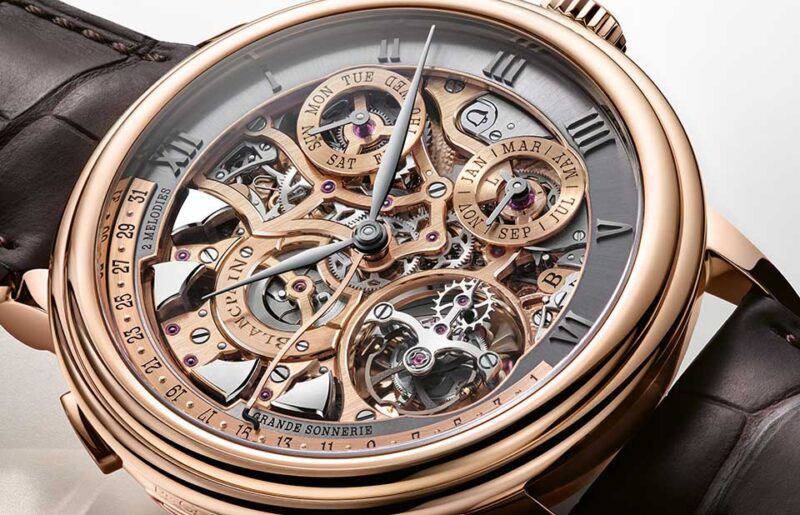
It is the world’s first grande sonnerie capable of performing two distinct four-note quarter-hour melodies, selectable by the wearer, and also the first to sound the complete four-bar melody after the hour strike at every full hour. This is achieved while retaining the full functionality of a grande et petite sonnerie and a minute repeater without duplicating the strike train, the hammers or the gongs.
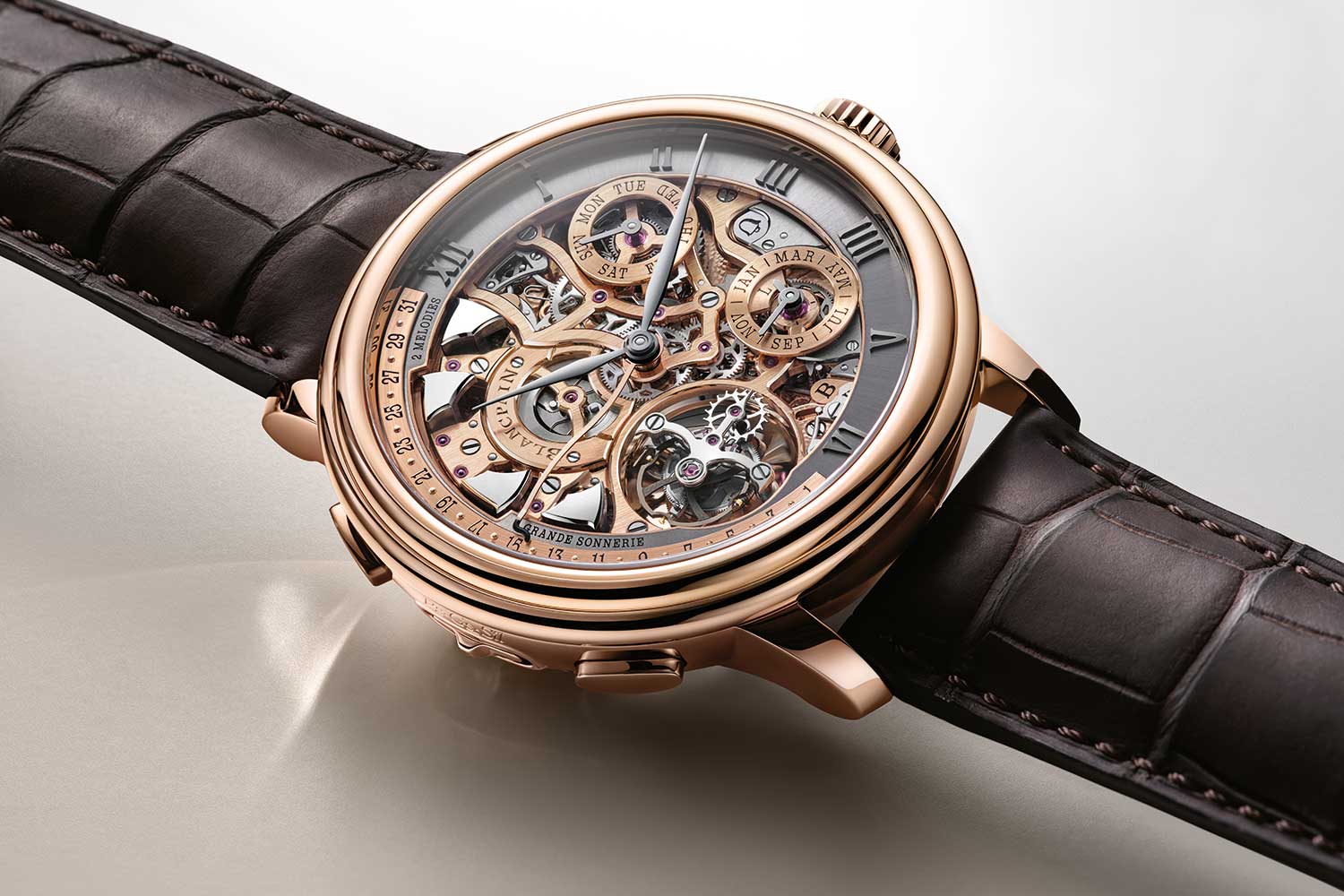
Blancpain Grande Double Sonnerie
In grande sonnerie mode, the watch strikes the hour count at each quarter, then plays the appropriate portion of the selected four-note melody; at the top of the hour, the hour strike is followed by the complete four-bar sequence. In petite sonnerie mode, the hours are struck only on the full hour, again followed by the full melody, while each quarter is marked solely by its respective melodic segment, without repeating the hour count. The minute repeater operates on demand, sounding the hours, then the relevant quarter melody, and finally the minutes whenever the wearer activates it. The two melodies — Westminster chime or Blancpain’s original composition developed in collaboration with Eric Singer — can be selected instantly via a pusher on the caseband.

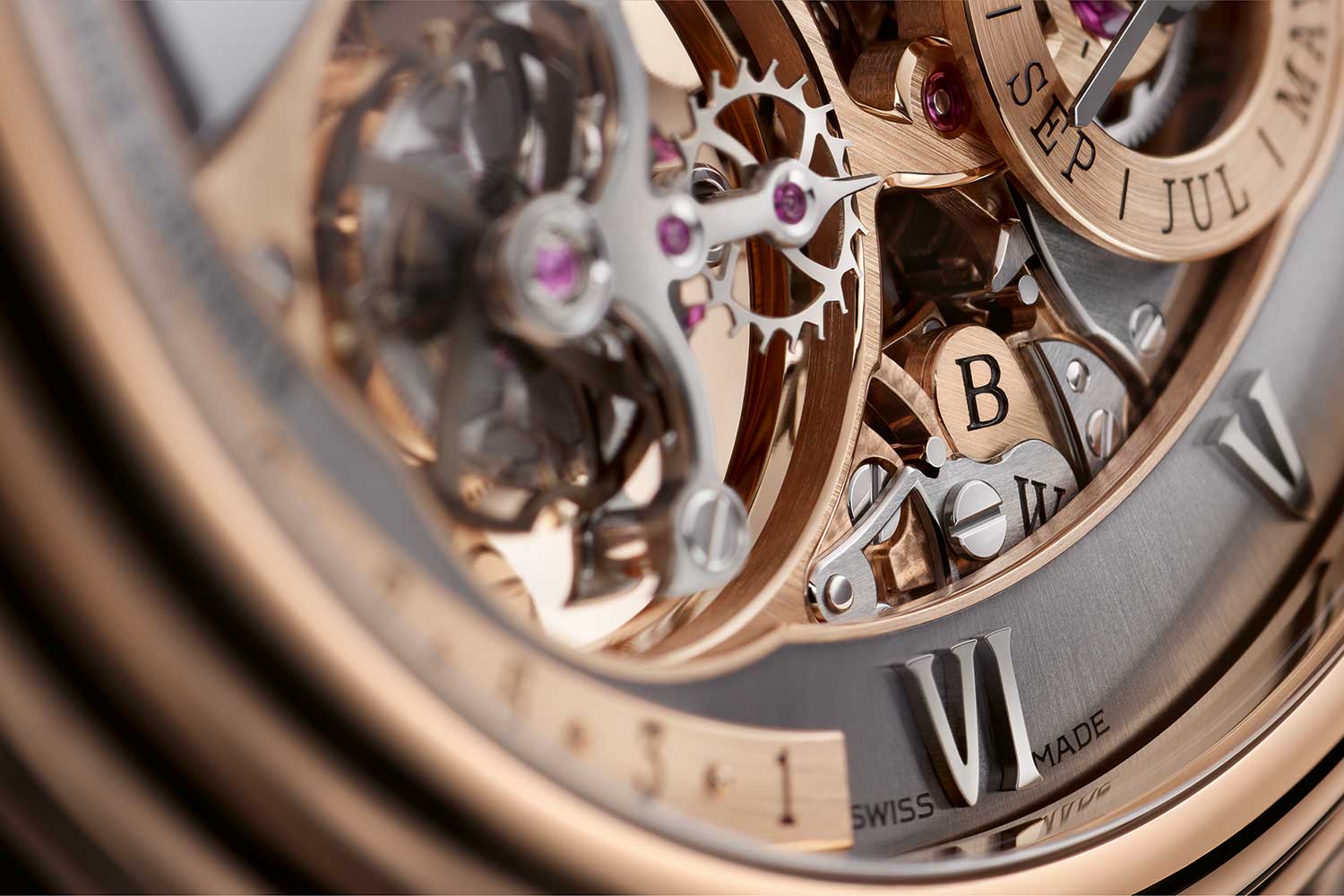
Close-up of the 4Hz flying tourbillon
Mechanically, this is governed by a selector linked to the case, which controls a cam defining the three operating modes: grande sonnerie, petite sonnerie and silent. A four-tooth star mounted on the cannon pinion releases the striking mechanism at each quarter, lifting the main lever that drives the racks. In grande sonnerie mode, the cam allows the hour rack to read the hour snail at every release, ensuring the hours are always repeated before the melody. In petite sonnerie mode, a dedicated blocking lever prevents the hour rack from falling at the quarters while leaving it free at the full hour; an hour cam on the same star lifts this lever at the top of the hour, allowing the hour to be struck once before the melody. In silent mode, a silencing lever disengages the striking train entirely, while preserving minute repeater functionality as long as sufficient energy remains in the strike barrel.

Assembling the gongs
The main event, however, lies in the ability to switch between two different melodies. At the heart of the mechanism is a system that determines which hammers are permitted to strike and when. Blancpain achieves this through two superimposed quarter racks, each with a distinct tooth pattern — one for the Westminster sequence and the other for Blancpain’s original composition. They work in concert with releasable control lifts arranged in parallel planes, each acting as a mechanical gate between the rotating strike control and a hammer stop. When a lift is engaged, the hammer is free to strike; when it is held in a released position, that hammer remains silent, even as the rest of the strike sequence proceeds.

A closer look at the unusual strike works that consist of two quarter racks, each with a different tooth pattern: one for the Westminster sequence and the other for Blancpain’s original composition

Melody selection is handled by a column-wheel-controlled set of slides that reposition entire groups of lifts simultaneously. Paired lifts corresponding to the same hammer are mechanically interlocked so that only one can ever be active at a time.

The selector button
That achievement alone would justify the award. That it is accompanied by an ingeniously compact retrograde perpetual calendar only reinforces the point. In a year marked by breakthroughs, Blancpain has demonstrated unequivocally that classical mechanics still has something new to say.
Blancpain

You may also like
Editorial
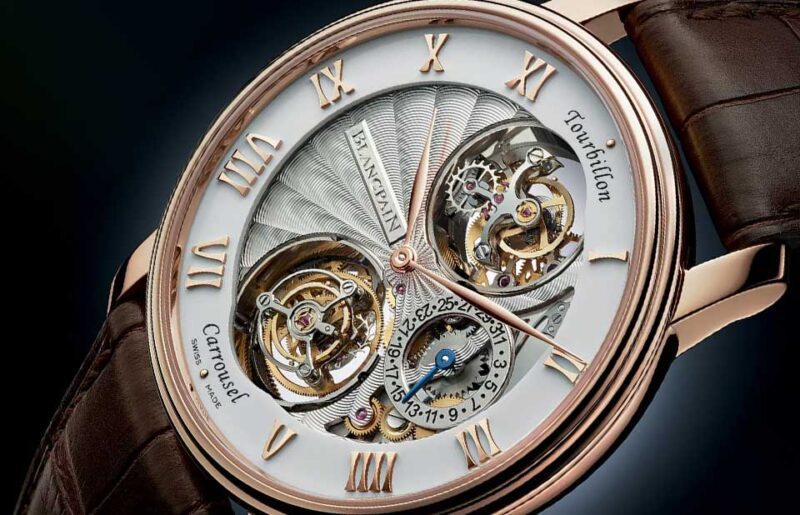
The Revolutionary List: 24 Technically Brilliant Watches – Blancpain Villeret Tourbillon Carrousel
Dec 12, 2025
Editorial
The Revolutionary List: 24 Technically Brilliant Watches – Blancpain Villeret Tourbillon Carrousel
Dec 12, 2025
Editorial
The Revolutionary List: 24 Technically Brilliant Watches – the Blancpain Grande Double Sonnerie
Dec 12, 2025
Editorial
The Revolutionary List: 24 Technically Brilliant Watches – the Blancpain Grande Double Sonnerie
Dec 12, 2025

Editorial
The Revolutionary List – 26 Inspirational Leaders: Marc Hayek
Dec 1, 2025
Editorial
The Revolutionary List – 26 Inspirational Leaders: Marc Hayek
Dec 1, 2025