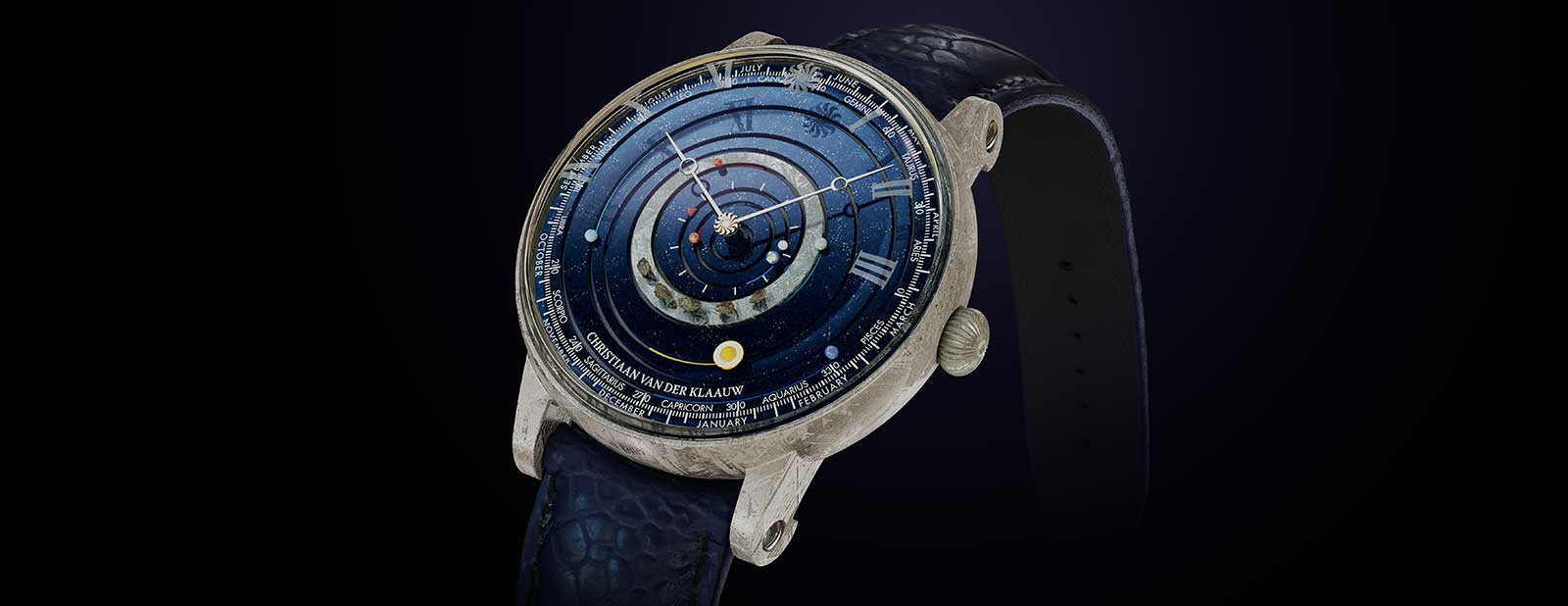
Christiaan van der Klaauw Introduces the Grand Planetarium Eccentric Meteorite
News
Christiaan van der Klaauw Introduces the Grand Planetarium Eccentric Meteorite

Of all astronomical complications known to watchmaking, few have the ability to draw us beyond ourselves quite like a planetarium; it is one of the most conceptually ambitious and visually, the most entrancing. It gives a visceral sense of scale and the differing orbital speeds, placing our notion of time within the vast, indifferent machinery of the solar system. In some ways, it is a visceral reminder that timekeeping began not with mechanisms of our own making, but with those already set in motion in the heavens.
The complication found its most complete expression in a wristwatch in 2024 – the Christiaan van der Klaauw Grand Planetarium Eccentric. It is the first and only mechanical wristwatch to display the real-time orbits of all eight planets in our solar system. It’s one thing to know Neptune takes about 165 years to orbit the Sun, just as a secular perpetual calendar will remain accurate until the current Gregorian cycle itself breaks down. But it’s another thing to witness that scale of time made tangible with Neptune creeping imperceptibly as Earth completes laps. It is this contrast that gives the display its quiet gravity – a portrayal not just of motion, but of perspective. Though it builds on the legacy of the brand’s earlier planetarium module, its construction is entirely different and significantly more complex.
This year, the brand introduced its most evocative – and most expensive – edition yet: the Grand Planetarium Eccentric Meteorite, featuring a case fashioned from solid iron-nickel meteorite. The choice of material is deeply appropriate, having been formed in the earliest epochs of the Solar System and now encasing a mechanism that seeks to reflect its ongoing motion
Christiaan van der Klaauw Grand Planetarium Eccentric Meteorite
Meteorite Case
The case of the Grand Planetarium Eccentric measures 44mm wide and 14.3mm high. Clearly, this isn’t meant to be a discreet daily companion, but a spectacular showpiece, and if a watch is to take up serious real estate, it might as well contain the entire Solar System. Much of the thickness is due to the complexity of the module within, though the case itself warrants closer attention. It is constructed entirely from meteorite. These iron meteorites were formed over 4.5 billion years ago when early planetesimals grew large enough for internal melting and differentiation. Heavier elements like iron and nickel sank to their centres, forming metallic cores. When these bodies were later shattered by massive collisions in the asteroid belt, fragments of their solidified cores were launched into space. Over millions, sometimes hundreds of millions of years, these fragments drifted through the solar system before eventually being captured by Earth’s gravity.
Even earlier, the iron itself originated in the cores of massive stars, forged through nuclear fusion and dispersed across the cosmos by supernovae. As a result, every piece of meteorite carries a deep-time story written in iron. When cut and etched, it reveals striking internal patterns – elongated interlocking crystals of kamacite and taenite known as Widmanstätten patterns, named after Count Alois von Beckh Widmanstätten, who described them in 1808.
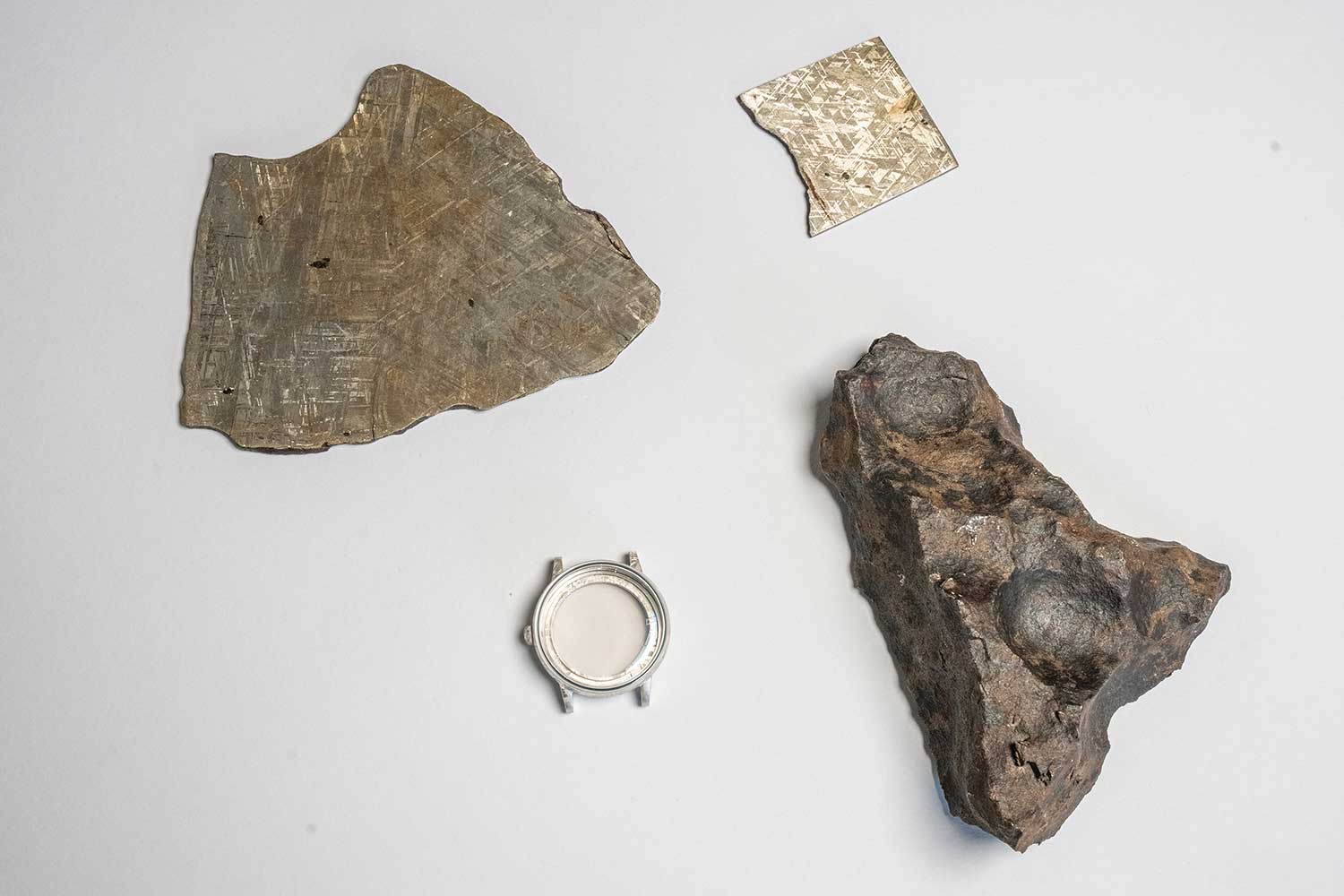
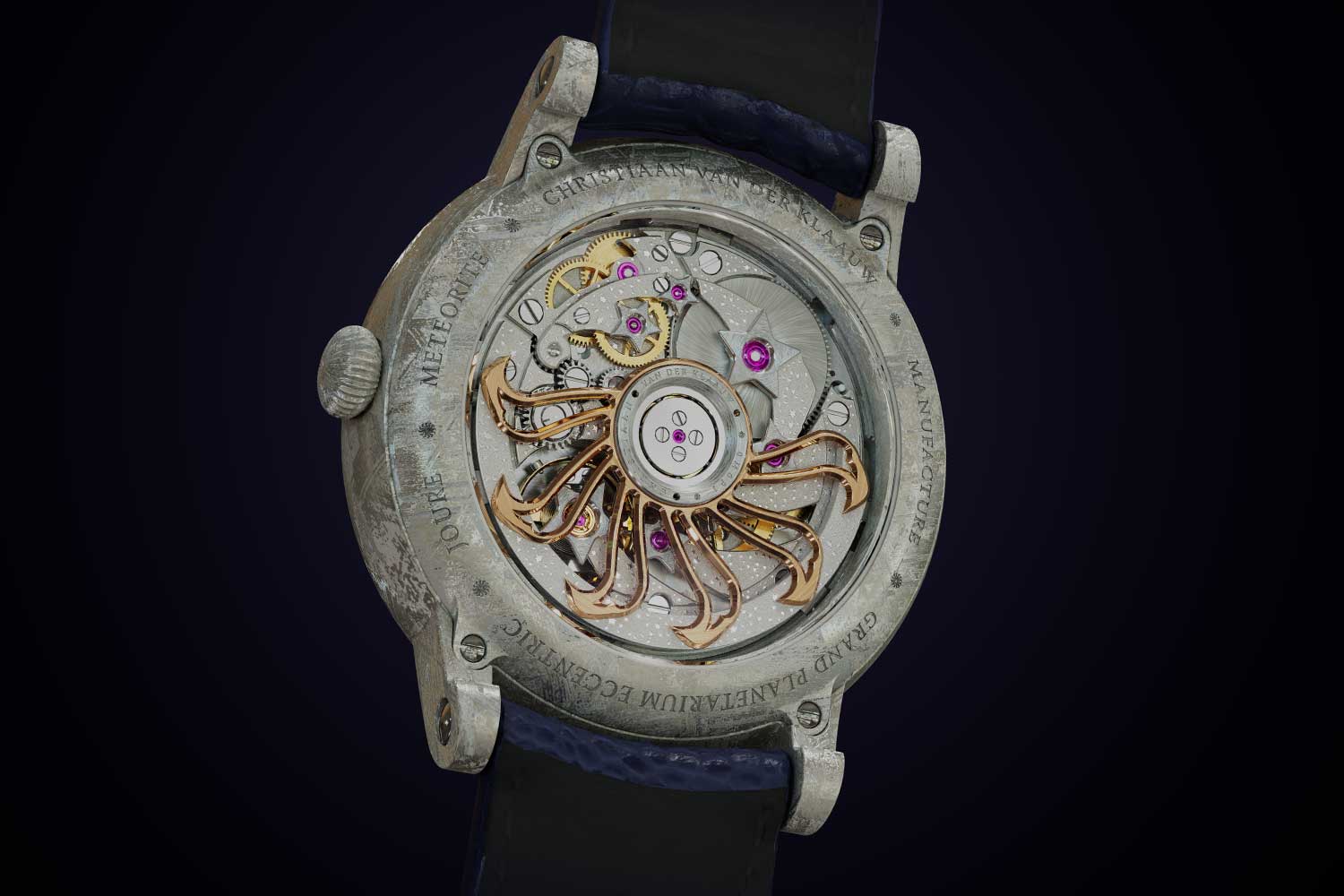
Creating a full meteorite case including the mid case, caseback, and crown was no small undertaking. The watch is limited to three pieces, but only two cases have been produced so far from a total of 1.09 kilograms of raw meteorite, with each case weighing just 47 grams. The final piece remains subject to availability.
Pim Koeslag, owner and CEO of CVDK explains, “The material, composed primarily of iron and nickel, also contains carbon in a form nearly as hard as diamond. As a result, it can only be machined with diamond tooling. Even then, the process remains exceptionally demanding, taking roughly four times longer than machining a platinum case.”

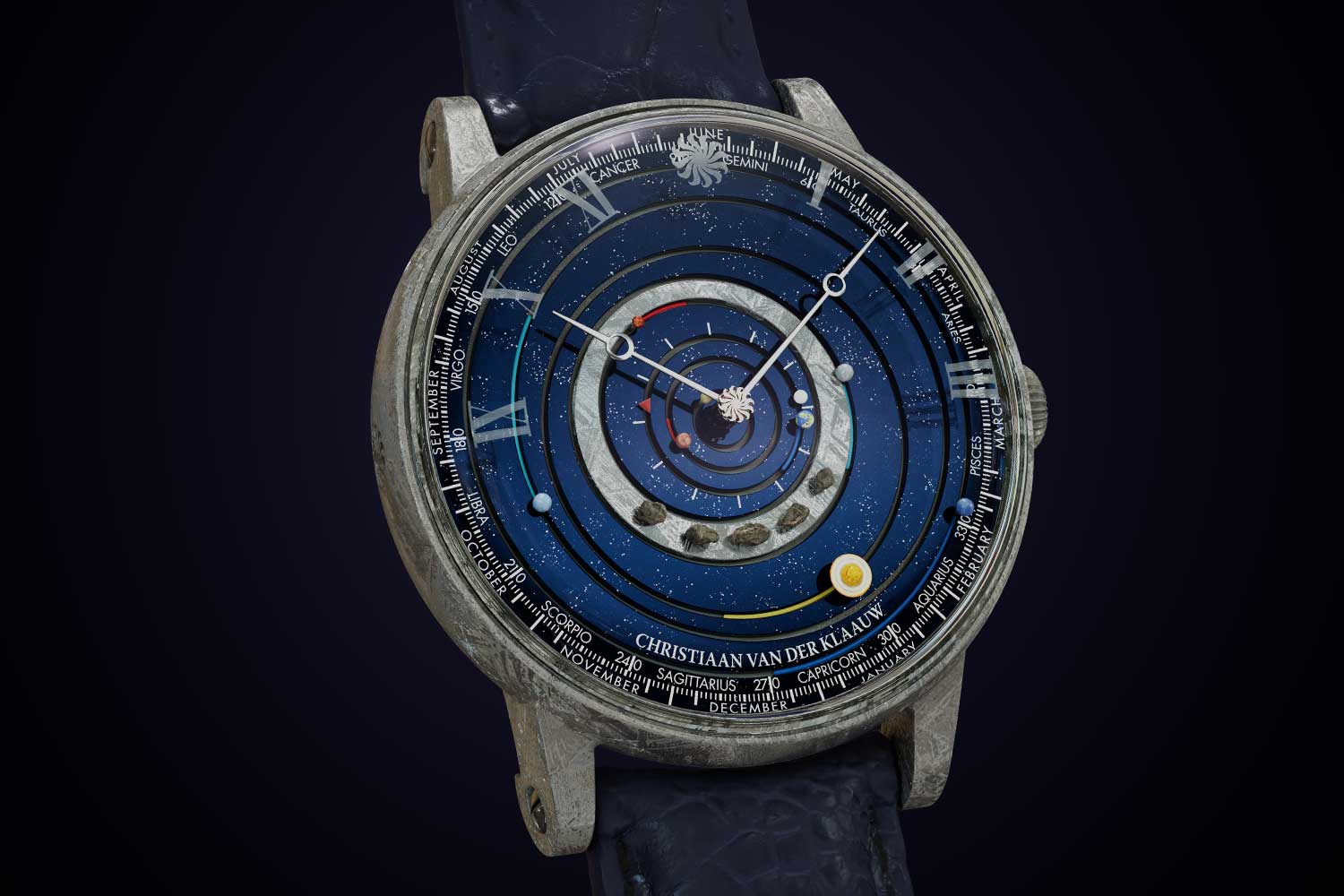
The dial itself consists of nine pieces of aventurine glass, and 22 screws were required to fix the dial alone. The planets were painted by hand, and between the orbits of Mars and Jupiter on the dial is a meteorite ring representing the asteroid belt, a diffuse band of rocky debris believed to be the remnants of planetary building blocks which never coalesced into a planet, due to the disruptive gravitational influence of Jupiter.
Set within this ring are actual fragments of a Martian nakhlite meteorite. They are among the rarest and most scientifically valuable meteorites ever discovered. Unlike iron-nickel meteorites, nakhlites are stony meteorites formed from ancient lava flows on Mars. They were blasted off the surface of Mars by asteroid impacts strong enough to overcome Mars’ gravity. This process is rare and dateable. Nakhlites are believed to have been ejected around 11 million years ago, which is relatively recent in cosmic terms.
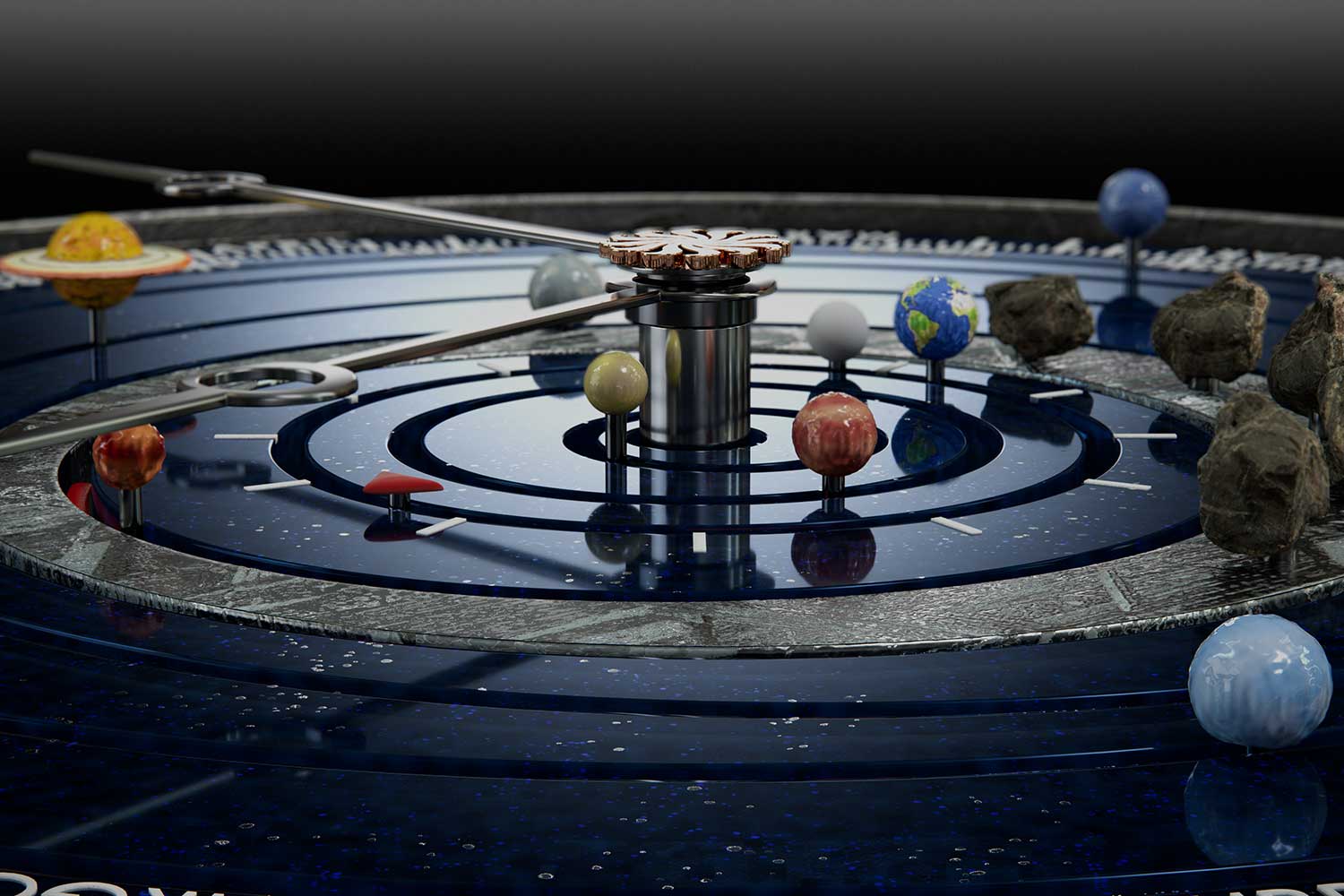
The planets were delicately hand-painted by a miniature painter in Geneva, using a squirrel hair under a microscope

The planets and raised coloured sections visible on the dial are fixed to their respective ring gear
What results is a profound meditation on time, scale, and origin, where ancient matter meets a mechanism that maps the cosmos in motion.
Motions of Distant Planets Reduced to Ratios and Rotations
The module was designed by Christiaan van der Klaauw himself. As Koeslag recounts, “When I saw him just a couple months after I acquired the company, he told me that he was working on this. I suggested we could create this for the 50th anniversary of the company. And so he showed me some drawings. He had 10 or 15 of those A3 drawings. I asked him to add the two planets and he created the drawings by pencil and compass, and all the calculations were written by hand.” Only after the full system was worked out on paper were the numbers entered into CAD to generate a 3D model.
To recap, the original module van der Klaauw developed for what remains the world’s smallest planetarium, measuring just 15mm across, is complex, yet conceptually straightforward. The planetary discs are gears themselves with raised peripheries. They were stacked vertically on a common arbour like an inverted pyramid each carrying a different planet. The planetary wheels were driven by a counter-stack of gears also vertically arranged, which meshed with them to modulate the orbital speeds. Because of this unique configuration – stacked gears with raised peripheries – the module is thicker than typical dial-side complications. Still, it remains a remarkably elegant and compact solution for modelling the orbits of six planets in real time.

The original module was the world’s smallest mechanical planetarium, displaying the orbits of the six innermost planets out to Saturn
In the Grand Planetarium, the planetarium spans the entire dial, displaying the orbits of all eight planets from Mercury to Neptune. Each follows a circular path with an eccentric placement that serves to mimic the asymmetric nature of their elliptical orbits around the Sun. As no patent has been filed, the 3D rendering provided by Koeslag below is an abstraction and not the complete model. Both Uranus and Neptune, which are the slowest-moving planets with orbital periods of 84.02 and 164.80 years respectively are absent from this CAD rendering as well as from van der Klaauw’s hand-drawn plan.
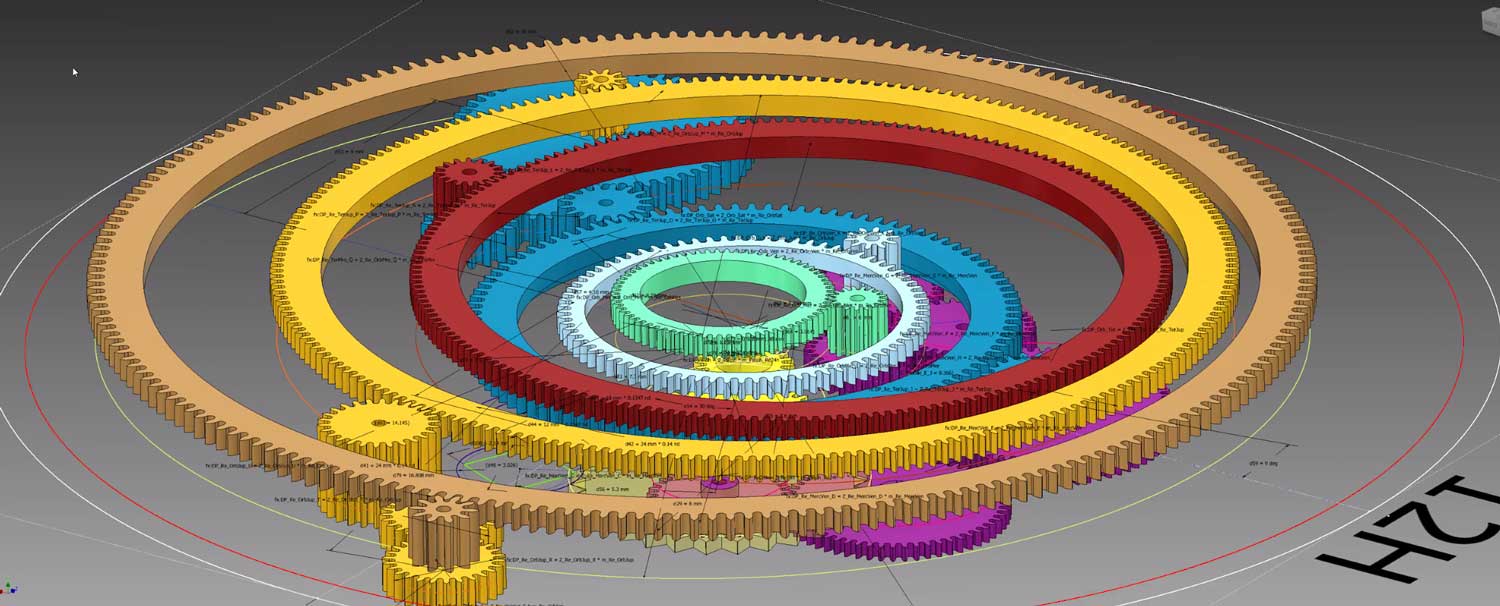
CAD drawing of the Grand Planetarium module (Image: Pim Koeslag)
The entire module is a massive gear train that begins at the 12-hour wheel in the motion works. Through a compound reduction train (made up of yellow and magenta gears in the CAD drawing), this motion is stepped down to produce a gear that completes one rotation every 365.25 days which becomes the gear for Earth (in blue). From there, two branches of the gear train extend radially to match the sidereal period of each planet: one toward the centre to drive Mercury (green) and Venus (light blue), and the other toward the periphery to drive Mars (red), Jupiter (yellow), and Saturn (beige). The inner gears, corresponding to Mercury and Venus, require higher angular velocities relative to Earth. This necessitates a gear-up configuration, achieved via pinions of smaller diameter driven from the Earth gear or its intermediary stages. Conversely, the outer planetary gears (red, yellow, beige) represent orbits with much longer sidereal periods, ranging from 686.98 days for Mars to 29.46 years for Saturn. These require gear-down configurations, implemented via larger gears driven by intermediary pinions that progressively reduce the input speed.
The hand drawing itself, dated and signed by van der Klaauw, is extremely impressive. There’s no reliance on software simulation; instead, it reflects a deeply intuitive, spatial understanding of gear ratios, centre distances, mesh points and orbital paths, which echoes the legacy of orrery builders and astronomical clockmakers of the 17th and 18th centuries. This is extremely rare among modern watchmakers; few can design a mechanism of this kind from first principles.

Hand-drawn plan executed at a scale of 10:1, by Christiaan van der Klaauw (Image: Pim Koeslag)
Encircling the dial is a month ring on the outermost edge, with a zodiac scale positioned just inside it. Together, they provide a visual representation of the Sun’s position in the zodiac throughout the year. This information is easily read via a red triangular indicator located directly opposite Earth’s position on the dial.

The module is mounted atop the brand’s proprietary automatic movement introduced last year. Seven stars decorate the bridges of the calibre. Each wheel in the going train, along with the balance wheel, is supported by a finger bridge tipped with a star forming a stylised depiction of a shooting star. The bridges themselves are decorated with a frosted star pattern created via laser engraving. Each star is circular grained, and the baseplate is finished with perlage.

In the end, the ingenuity behind the Grand Planetarium is matched only by the sheer emotional impact of having collapsed incomprehensible distances and timespans into a form that is both tactile and human. It reframes time not as a human construct but as a physical phenomenon, and in doing so, connects the wearer to something far older, far larger, and far more enduring than any individual lifetime. Thanks to that, and a case born in the furnace of stars and hurled through the void for millions of years, the Grand Planetarium Meteorite commands an eye-watering €700,000. Just two have been made and both have already found their place.
Tech Specs: Christiaan van der Klaauw Grand Planetarium Eccentric Meteorite
Reference: SLGC007
Movement: Self-winding Manufacture movement; 60-hour power reserve; 21,600 vph or 3Hz
Functions: Hours and minutes; central seconds-indicator (rotating sun logo); the current month and approximate date, Sun’s position in the zodiac; planetarium showing the orbits of Mercury, Venus, Earth, Mars, Jupiter, Saturn, Uranus and Neptune
Case: 44mm by 14.4mm.; meteorite
Dial: Aventurine glass with meteorite ring
Strap: Dark blue leather strap with platinum folding clasp
Availability: Limited to 3 pieces
Price: €700,000 (incl. taxes)
Christiaan Van Der Klaauw
You may also like
Watches & Wonders 2025: All The First-Time Exhibitors
Apr 6, 2025
Watches & Wonders 2025: All The First-Time Exhibitors
Apr 6, 2025

News
Sincere Fine Watches 70th Anniversary: The Exclusive CVDK Grand Planetarium Eccentric Sincere Platinum Jubilee Edition
Nov 7, 2024
News
Sincere Fine Watches 70th Anniversary: The Exclusive CVDK Grand Planetarium Eccentric Sincere Platinum Jubilee Edition
Nov 7, 2024

Video
Galaxy On Your Wrist: Christiaan van der Klaauw x Revolution Planetarium Prometheus
Aug 12, 2024
Video
Galaxy On Your Wrist: Christiaan van der Klaauw x Revolution Planetarium Prometheus
Aug 12, 2024